
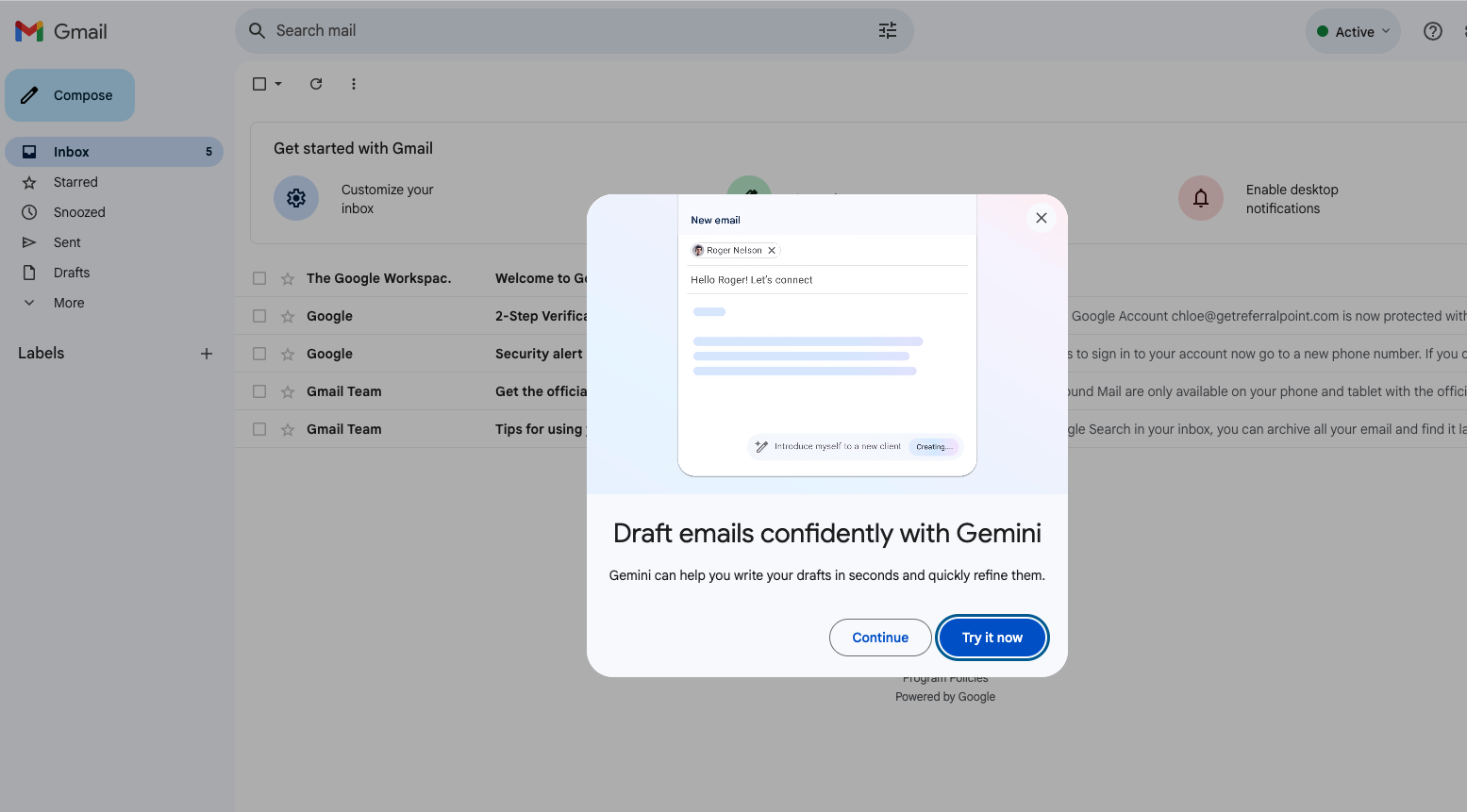
When Google launched Gemini inside Gmail, they didn’t rely on blog posts, ads, or email campaigns to drive adoption. Instead, they used a contextual, in-app popup—shown at the exact moment a user was writing an email—to introduce the AI writer.
That decision highlights a larger shift happening across SaaS:
The product experience itself is becoming the highest-converting marketing and revenue channel.
This is exactly where Upvert comes in.
Gemini succeeds because it’s:
There’s no friction, no context switching, and no guessing what the user needs.
Most B2B companies, however, still rely on:
The result?
Average B2B websites convert just 1–2% of visitors .
Upvert applies the same principles behind Gemini’s success to both websites and in-product experiences.
Instead of generic popups, Upvert enables:
Industry benchmarks show:
Upvert is built specifically to operate in the high-relevance category—where timing, context, and intent align.
Gemini works because Google understands user context. Upvert brings that same intelligence to B2B teams by combining:
Over 95% of B2B website visitors are anonymous .
Upvert identifies:
This allows popups to trigger only when they matter.
Upvert’s core product—personalized microsites—outperform static landing pages by aligning messaging to the visitor’s real context.
Benchmarks show:
Instead of pushing everyone to the same demo page, Upvert adapts:
Upvert doesn’t treat popups as interruptions. They’re used as:
Just like Gemini’s Gmail popup, they appear:
With Upvert, teams move from:
Even a shift from 1% → 2% conversion doubles pipeline without increasing spend .
By combining:
Upvert turns your product and website into always-on revenue channels.
Gemini shows us the future:
Upvert makes this future accessible to B2B teams—without Google-level data or engineering effort.
Static pages don’t convert.
Generic popups don’t scale.
Contextual experiences win.
And that’s exactly what Upvert delivers.


.svg)