
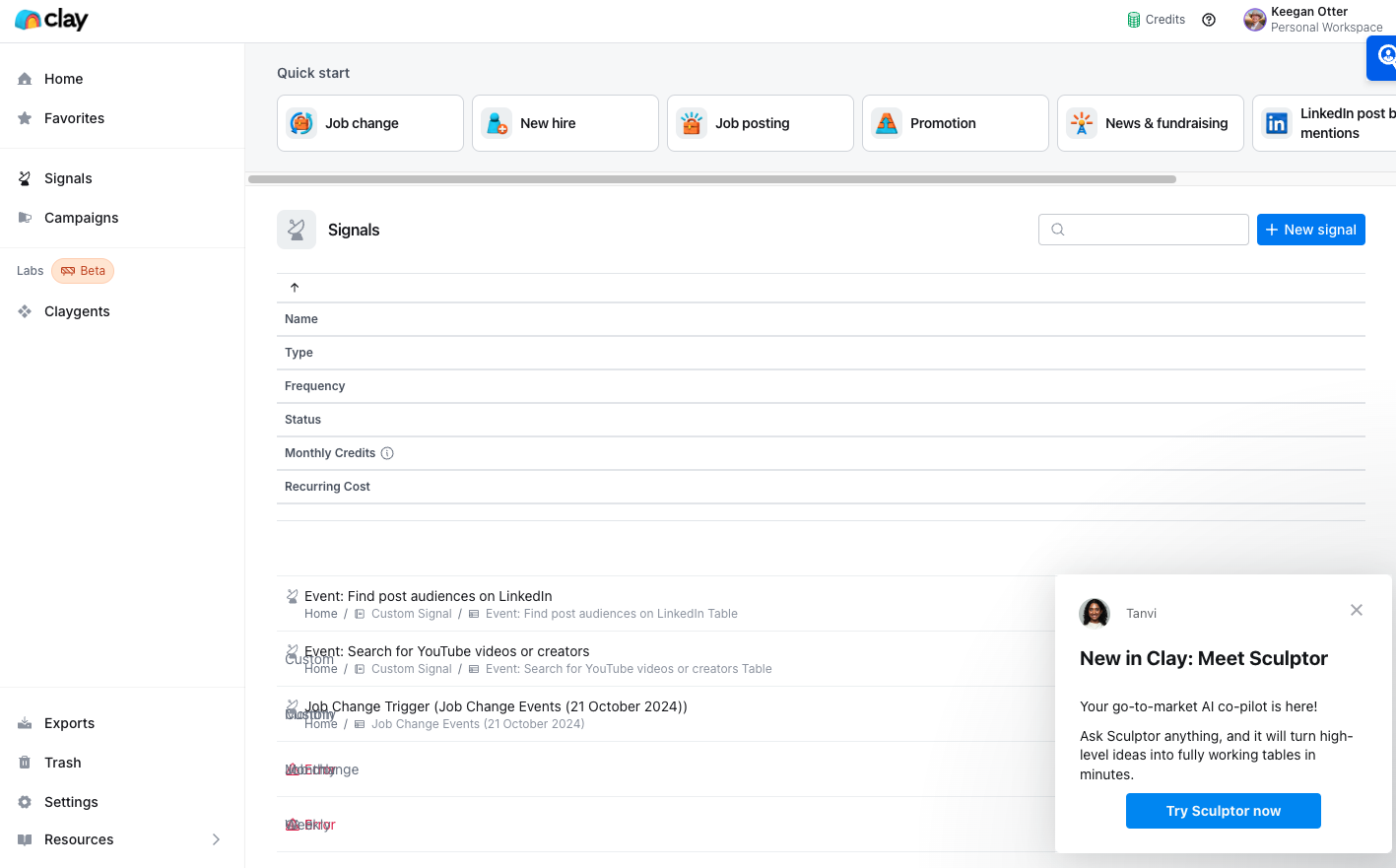
Modern SaaS growth isn’t just about acquiring users—it’s about activating them, educating them, and expanding revenue inside the product. Clay is a strong example of how in-app popups, modals, and notifications can be used tastefully to introduce new features, guide behavior, and upsell users at the right moment.
Rather than relying solely on email or external marketing, Clay brings growth directly into the product experience.
Most B2B products struggle with a few core problems:
In-app popups solve this by surfacing contextual value at the moment of intent.
Industry data backs this up:
Clay leverages these mechanics inside the product—where attention is already high.
Clay uses in-app modals to announce:
Why it works:
Instead of sending users to a blog or email, Clay explains what’s new, why it matters, and how to try it—without breaking flow.
This shortens time-to-value and increases feature adoption dramatically.
Clay doesn’t upsell randomly.
Popups appear when users:
This mirrors a key personalization principle:
Upsells convert best when users already understand the value.
Relevant data shows:
Clay’s in-app prompts act as personalized CTAs, triggered by behavior—not guesses.
Many SaaS companies depend on:
Clay moves these nudges inside the product, where:
This is especially powerful when you consider that:
In-app popups bypass the weakest conversion surface (the website) and operate where intent already exists.
Clay’s approach highlights a broader shift in growth strategy:
The product is the best marketing channel.
In-app popups work best when they are:
When combined with personalization and intent data, popups become:
Clay shows that in-app popups aren’t interruptions—they’re guided moments of value.
By surfacing the right message, to the right user, at the right time, Clay turns:
For SaaS teams looking to grow efficiently, this is the playbook:
Build growth directly into the product experience.
👉🏻 Try Upvert for free today.


.svg)